
Micros: Easily Overlooked and 3 Ways to Get Them

What are Micros?

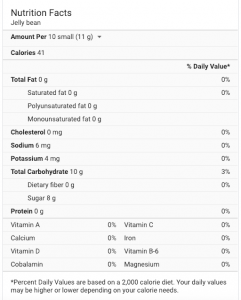
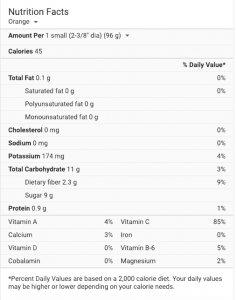
Macro is a word often heard in the fitness community. Many of us have probably heard people say, “I’ll eat it as long as if it fits my macros.”  But, something that is easily overlooked is micros. “Micronutrients are dietary components, often referred to as vitamins and minerals, which although only required by the body in small amounts, are vital to development, disease prevention, and wellbeing,” (CDC.gov).  A lot of times when we focus on eating healthy, we direct our attention to the protein, fats and carbs on the nutrition labels, but we don’t focus on all the vitamins and minerals we may or may not be getting.  Ultimately it comes down to food choices. For example, let’s compare an orange and a jellybean.

10 Jelly Beans Nutrition:

Fat: 0g

Carbs: 10g

Protein: 0g

1 Small Orange Nutrition:

Fat: 0.1g

Carbs: 11g

Protein: .9g

On a Macro level, these two foods look like they are pretty similar – about 10g of carbs per serving.  But, on a Micro level, these two foods are very different:
Here are 3 Ways to Ensure You are Getting the Micronutrients You Need:

1.     Shop the outer rim of the grocery store: Food choices are very important when it comes to micronutrients. The outer rim is typically fresh whole foods, which means that they will be packed with both macronutrients and micronutrients.  Typically things that are frozen or come from a bag or box will not give you the micronutrients you need.

2.     Eat Your Fruits and Veggies: Fruits and Veggies are packed with all kinds of micronutrients.

3.     Supplementation: Food is always the best source to get your micronutrients, but this can often be a challenge. This is where supplements come into play.  Taking a multi-vitamin and fish oil is very foundational for most adults. If you’re not a huge fan of veggies, or have some digestion issues, adding a green supplement into your regimen could be a good idea too.  Here’s the supplement stack we recommend: https://1stphorm.com/products/stacks/sports-performance/the-essential-stack (You also get FREE shipping using that link!)

Balance is Key

The key to optimal nutrition fueling is consuming a variety of fruits and vegetables, healthy proteins, and carbohydrates. You want to limit your consumption of refined process carbs like sugary cereal, syrups, candy, cookies, ect. Aim for one meal every 2-4 hours to meet your daily caloric requirements. This may vary from person to person based on sex, age, weight, height, and activity level.

For more information schedule a nutrition consultation today!

Macros: The Building Blocks to Fueling Performance

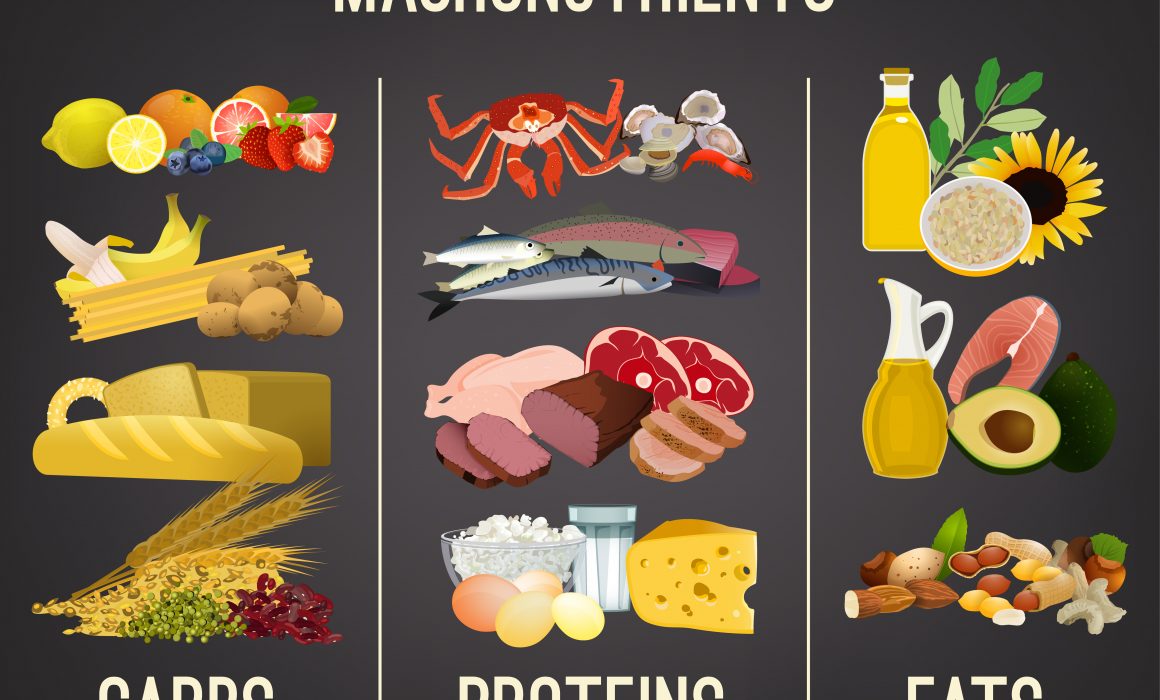
Proteins, carbohydrates and fats are the three main suppliers of nutrients in our diet. These are known as macronutrients or “macros”. Macros play a vital role in our ability to perform at our peak level. Athletes can practice for hours but unless they fuel their bodies properly they will not reach their peak performance. Food is our fuel source for our body to be able to get stronger, faster, recover and perform. If you feel tired, sluggish, have a decrease in performance, always sore muscles, injuries that won’t heal, or a crash in the middle of game or practice; these are all signs that you are not fueling correctly.  Below is a guide for building healthy macronutrients into your nutrition plan.

Protein

Protein is essential to building and repairing muscle to enhance strength and power. It is commonly found in animal products, although it is also present in other sources, such as nuts and legumes. 

Here are the benefits of consuming protein. 

  • Build and repair muscle tissue
  • Heal tissues/injuries
  • Building blocks of bones, muscles, cartilage, skin and blood. 
  • Keeps us full and satisfied

Protein Sources

  • Beef:Grass fed ground beef, bison, elk, venison, pork
  • Fish: Salmon, shrimp, tuna, scallops, halibut (or any white fish)
  • Poultry: Eggs, Chicken, Turkey (white or dark meat)
  • Dairy: Milk, Greek yogurt, cottage cheese, string cheese, cheese
  • Beans: Beans (any variety? Or only specific ones) contain more protein than any other vegetable protein. Plus, they’re loaded with fiber that helps you feel full for hours.
  • Nuts/Seeds: One ounce of almonds gives you 6 grams of protein-almonds, cashews, pistachios, peanuts, pumpkin seeds, chia/flax etc. 
  • Protein bars and Powders: Rx bar, Dales raw protein bars, bullet proof bars, oatmega bars, primal kitchen collagen bars, Epic or tanka meat bars

Aim to have a protein source at each meal!! (about 20-30g per meal)

Carbohydrates

Carbohydrates are sugars, starches and fibers found in fruits, grains, vegetables and milk products. Carbohydrates are very important to supplying energy for high performance during sport activities. There is a lot of information on carb-free diets, these are detrimental to an athlete. Carbs are the bodies preferred source of fuel. There are healthy and non-healthy carbs. Any carb that involves processed sugar would be a bad carb (cookies, cake, sugary cereal,). Good carbs are listed below. 

Benefits of Carbs

  • Fuel training and help with recovery 
  • Preserves muscle and glycogen (fuel sources)
  • Helps with recovery to be ready to go for next game or practice

Best Carb Sources 

  • Whole grains:oats, quinoa, wild rice, brown rice, faro, couscous, whole wheat pasta, whole wheat bread
  • Fruits:Bananas great pre/post workout snack. Include a variety of fruits in your day
  • Vegetables:starchy-sweet potatoes, squash, parsnips, beets, potatoes, peas, corn. Non-starchy-broccoli, cauliflower, celery, tomatoes, cucumbers, carrots, greens, asparagus etc. Make sure to have a veggie at every meal
  • Beans:Great source of fiber to help stay full and satisfied

Fats

Although it gets a bad rap, fat is an important nutrient that the body needs in order to function. Eating the right amount and the right form of dietary fat is key to maintaining good health and performance. Fat plays a key role in sports performance because it functions as an energy reserve. 

  • Helps fuel our workouts during low intensity bouts
  • Primary fuel source at rest
  • Slow Digesting to keep you feeling full and satisfied longer 

Best Sources of fats

  • Nuts and seeds-1/4 cup is approximate serving. Include all varieties. 
  • Avocados
  • Dairy(2% or higher) Greek yogurt, cottage cheese, cheese, string cheese, milk, butter, ghee
  • Oils-extra virgin olive oil, coconut oil, avocado oil
  • Meats and fish-Wild salmon, grass fed beef, pork etc. 

Healthy Smoothie Recipes: These incorporate a protein, carb and fat.

1 scoop protein powder

1 fist of veggies (spinach works great)

1 Cup of berries

1-2 TBSP of nut or seed butter

8 oz Milk or unsweetened almond milk

Ice if desired 

            OR 

1 cup of Greek yogurt

1 big handful of spinach

1 banana

1-2 TBSP nut or seed butter

8oz of chocolate unsweetened almond milk

Balance is Key 

The key to optimal nutrition fueling is consuming a variety of fruits and vegetables, healthy proteins, and carbohydrates. You want to limit your consumption of refined process carbs like sugary cereal, syrups, candy, cookies, ect, the less you have, the better. Aim for one meal every 2-4 hours to meet your daily caloric requirements. This may vary from person to person based on sex, age, weight, height, and activity level. 

For more information schedule a nutrition consultation today!


The Sugar Epidemic

 Are you still feeling addicted to sugar from all the holiday indulging? Did you know that sugar cravings can last for 10 days (for most people)? Today I’m going to analyze the sugar epidemic in our culture and give you some steps to get rid of sugar cravings.

“Sugar is addictive and does stimulate the same pleasure centers of the brain as cocaine or heroin.” Daily Burn

Sugar is addictive, clearly. It can cause weight gain, increase your risk of heart disease, cause acne, increase your risk of diabetes and depression, drain your energy, and  lead to a fatty liver and more. Why has sugar become such an epidemic? Sugar and sweeteners are the main ingredients in  a lot of America’s food and drinks. The average American consumes about 20 teaspoons, or 80 grams, of sugar a day according to  Healthline. 

Many of our food choices that sound healthy, sneakily are packed with sugar. For example, eating  low-fat yogurt and a granola bar may sound like a good choice for breakfast.

In reality, a 6-ounce container of Dannon All Natural Plain Lowfat Yogurt has 12g of sugar.

A two-pack of Nature Valley Oats ’n’ Honey Granola Bars has 11g of sugar.  Did you

Did you know that the FDA does not regulate the verbiage “natural,” “pure,” and “nature?”  Often times foods that are being marketed in this way typically are not as  healthy as they seem.

13 percent of American adults’ total caloric daily intake come from added sugars! It’s  important for us to stop reading only the front label and start paying attention to the nutrition label. The American Heart Association and the World Health Organization recommend that less than 10 percent of a person’s diet should come from added sugars.

Ideally, most women should not consume more than 100 calories from sugar a day, or about 6 teaspoons. Men should only consume 150 calories from sugar, or 9 teaspoons.

 Here are some popular drinks and their sugar content:

12oz Pepsi: 10 Teaspoons of Sugar

23oz Arizona Iced Tea: 17 Teaspoons

32oz Powerade: 14 Teaspoons

20oz Starbucks White Mocha Frappuccino: 18 Teaspoons

There’s no doubt sugar is an epidemic and there’s vast amounts hiding in our foods and drinks. So, how do we avoid the sugar and get rid of the sugar cravings?

  1. Check Labels – read your labels, specifically the sugar content. Also check the ingredients. There are tons of other names for sugar including: syrup, corn syrup, crystalline fructose, dextrose, ethyl maltol, fructose, fruit juice, glucose, high-fructose corn syrup, honey, lactose, sucrose, and many more.
  2. Stay away from Soft Drinks and Juice
  3. Try to Avoid Adding Sugar – this included artificial sweeteners such as stevia.
  4. Eat Fruits instead of Sweets – fruit contains fructose, which will hit the spot, but your body metabolizes this differently than sweets.
  5. Out of Sight, Out of Mind – Simply create an environment where you can be successful! Don’t leave treats laying around, you’ll be more tempted when a sugar craving does come up.
  6. Manage your Magnesium Levels – research shows that people who are deficient in magnesium crave chocolate. Eating rich leafy greens, legumes and nuts can help!
  7. Balance – have a sweet every now and again. Allow yourself to have it when you crave it, just don’t overdo it. We tend to get into the restrict – binge cycle easily, so allowing yourself balance with your food choices will help you maintain good choices for long-term success. 

In conclusion, sugar has become an epidemic in today’s culture and we need to start paying attention to this ingredient.

Check out our Fit Tip Episode below!


Decrease in Performance: Undertraining or Lack of Recovery

“Coach, my vertical decreased.” “Why did my 10 yard dash get slower?” “I played well the first half of the game, but in the second I tanked.”

Coaches have you ever had a new athlete come to you with these questions or concerns? Sometimes even after “grinding” in the gym for months, following a “science based” program, or even training with another coach, an athletes performance doesn’t improve or even gets worse. So, what happened?  As performance coaches, we often celebrate the increases in performance by our athletes, but rarely examine the “why” the performance decreases. Below are two major reason why some athletes see their performance decrease when training.

What is Undertraining?

Undertraining is when an athletes training program or routine does not cause enough stress for the body to adapt to. The purpose of training is to elicit specific stressors that the body adapts to. If the stressors are not at an optimal level for that individual, there will be minimal to no performance increases. This can happen when athletes are continuously prescribed a generic training program that may not be suitable for their physiological ability. An example is performing ten pushups three times a week. To start this might be strenuous, but after three weeks if there is no increase in reps or intensity the body will no longer adapt and there will be no increase in performance. To avoid undertraining, athletes and coaches should use simple methods such as, *RPE scales after training sessions, and the *Daily Readiness test before. These tools can give athletes and coaches an idea of what level of stress was placed on the body during training.

Lack of Recovery

There are three recovery pillars: nutrition, sleep, and hydration. From my experience, most if not all athletes don’t spend nearly as much time recovering as they do training. Ideally, the training to recovery ratio is 1:2. This gives the body enough time to adapt to the new stressors of the previous training session and to prepare for the next session.

Simple recovery methods such as eating at least three meals a day, sleeping eight hours each night, and drinking a gallon of water each day is the best prescription for any athlete. Recovery is vital to performance and should be the first topic discussed with athletes as they start a new training program.

Key Takeaways

  • Training is testing. Athletes should be evaluated daily to ensure an optimal training program
  • Athletes should focus on recovery just as much or even more than the training

*RPE Scale

*Daily Readiness Scale


Self Talk: The Real Motivator

A huge part of motivation is what we tell ourselves, or self talk. Having positive self talk is key to success when it comes to fitness goals. According to expert neurologist we average 70,000 thoughts a day. These thoughts include both conscious and unconscious.  Conscious thoughts are dictated by our surroundings and environment, along with past experiences. Our views, outlook on life and perception of ourselves is determined by our different upbringings and life experiences. these experiences will dictate whether you have positive or negative self talk.

What is self talk?

Self-talk is the act of talking to yourself either outloud or mentally. The messages you tell yourself will encourage and motivate you, or they will limit you if they are negative. It’s important to recognize your inner voice so you can identify when you’re having positive or negative self talk.

Here is negative self talk that you want to avoid

  • Mind reading: assuming we understand what other people are thinking without any real evidence.
  • Overgeneralization: the habit of telling ourselves that a negative event is bound to continue happening in the future.
  •  Magnification: when we take our own errors or flaws and exaggerate them.
  • Minimization: the mirror image of magnification, being dismissive of our strengths and positive qualities.
  • Emotional reasoning:  the habit of making decisions based on how we feel rather than what we value.
  • Personalization: assuming excessive amounts of responsibility, especially for things that are mostly or entirely outside our control.
  • Fortune Telling: the mental habit of predicting what will happen based on little or no real evidence.
  • Should Statements: are a kind of self-talk we use to try and motivate ourselves by always telling ourselves what we should and should not do.


In order to combat negative self talk use these positive self talk strategies

  1.      Have a purpose higher than yourself
  2.      Cut negative people out of your life
  3.      Be grateful
  4.      Don’t compare yourself to others
  5.      Use positivity with others
  6.      Believe in your success
  7.      Don’t fear failure
  8.      Replace negative thoughts with positive one
  9.      Positive affirmation
  10.   Don’t dwell in the past
  11.   Visualize your success
  12.   Limit your intake of news and media
  13.   Help others
  14.   Be physically active
  15.   Dream and set goals

When and how to be effective at self talk?

In order to be effective at self talk you must make it a habit. To start, Every morning think of something that you are a grateful for and give thanks. Then give yourself positive affirmation such as:

  •      I am determined and successful
  •      I am confident
  •      I am strong
  •      My life has meaning and purpose
  •      I am in control of my choices
  •      I am not afraid to fail because it will help me grow

How is self talk is critical to building confidence?

Do you feel shy in front of a big audience? Do you have little belief in your talents and skills? Positive self-talk can Positive self-talk can make you feel more confident in these situations Negative self-talk will hinder you from performing at your fullest by allowing doubt to come into your thoughts. With positive self-talk, you can put your doubts aside and focus on accomplishing your feat successfully. Confidence and success go hand in hand. Those who are successful at what they do, truly believe in themselves and their abilities.  Confidence is so important to success that many psychologists believe that it is one of the primary prerequisites to personal and professional success. Be confident in everything you do by lifting yourself up with positive self talk.


The Truth About Core Training

The Truth About Core Training

What if we told you everything you know about core exercises is wrong?  Straining your neck and back doing hundreds of sit-ups, trying to get a “shredded six-pack,” is a complete waste of your time. Sure, you may feel “the burn” in your abs for two to three days after your workout, but that won’t compare to the burn you will feel in your back five years later from bad posture, due to those high repetition ab routines you used to do.

It is time we challenge the status quo when it comes to fitness and performance. I challenge you to be inquisitive and question the fitness content you consume in magazines, articles, blogs, social media, personal trainers, and performance coaches.

There are a lot of great well-educated fitness professionals out there, but the reality is, the fitness, strength, and conditioning industries are becoming over-saturated. A simple test must be taken in order to receive a personal training certification, but should that be enough to be considered a professional?

Technology and the advancement of social media have made it easier for people to share their thoughts, experiences, and opinions with a wider audience. This can be great in some cases, however, when individuals are given misinformation on effective exercise prescription, it can have a snowball effect on your health and wellness. This could potentially lead to muscle imbalance, joint pain, dysfunctions, and ultimately chronic injury or illness.

After reading this, you will have a clear understanding of what your “core” actually is and its purpose. You will also have information on effects your core strength has on your everyday life and insight on why you should change the way you train your core. You will also be given our top five functional core exercises.

What Exactly is Your “Core”?

Your core is a complex series of muscles, extending far beyond your abs, including everything besides your arms and legs. It is incorporated in almost every movement of the human body. Your core is comprised of the following muscle groups:

Pelvic floor muscles, Tansversus abdominis, Multifidus, Internal and external obliques, Rectus abdominis, Erector spinae (sacrospinalis), Erector spinae (sacrospinalis), Longissimus thoracis, Diaphragm, Latissimus dorsi, Gluteus maximus, Trapezius, Gluteus medius, Psoas major, and Serratus anterior.

Train your core the right way to prevent bad posture and other dysfunctions. The true purpose of your core is to stabilize your joints, which prevents unwanted movement and transfer of energy forces from your extremities.

Your core most often acts as a stabilizer and force transfer center rather than a primary mover. We often isolate our core with exercises like crunches or back extensions versus functional movements like deadlifts, overhead squats, and pushups, among many other functional exercises.

By training your core the right way, you can optimize the major function of your core. You will also enhance movement efficiency, strength in your muscles, and joints. Strengthening your core will help your tendons to prevent injury and future pain, which will aid long-term health.

How Strengthening Your Core Will Impact Your…

Everyday Life

A strong core enhances balance, stability, and energy transfer. Thus, it can help prevent injuries during day-to-day activities and sports injuries. Core strength directly correlates to exercise and sport activities like walking, jogging, sprinting, throwing, squatting, jumping, and swinging motions. The stronger your core is, the more efficient you will be at these activities. Through strengthening your core, you will see an increase in your performance as well as minimize your risk for injuries.  

Everyday Activities

Bending to put on shoes or scoop up a package, turning to look behind you, sitting in a chair, or simply standing still. These are just a few of the many mundane actions that rely on your core and that you might not notice until they become difficult or painful. Even basic activities of daily living bathing or dressing, for example call on your core.

Work Place

Jobs that involve lifting, twisting, and standing all rely on core muscles. But less obvious tasks like sitting at your desk for hours engage your core as well. Phone calls, typing, computer use, and similar work can make back muscles stiff and sore, particularly if you’re not strong enough to practice good posture and aren’t taking sufficient breaks to stand and go for a walk.

Sports and Other Activities

Sports comprise of a series of explosive complex movements that require a lot of core strength and satiability. Think of sports like golfing, tennis, baseball, and softball. The rotational nature of these sports causes the spine to twist and coil up just to be rapidly released in the opposite direction. Without good foundational core strength, these movements can cause serious harm to your body.

Other sports like basketball, football, hockey, lacrosse, and soccer require speed, agility, coordination, strength, and balance. All this qualities are built on and enhanced by having a solid core. Even recreational sports like running, swimming, kayaking, rowing, skiing, and snowboarding heavily rely on your core.  So, it is important to consider training your core when participating in these hobbies we love.

Good Posture

Good posture decreases wear and tear on your spine and allows you to breathe deeply. Good posture also allows you to perform everyday task easily and more efficiently saving you time and energy.

Weak, tight, or unbalanced core muscles can undermine you in any of these realms. And while it’s important to build a strong core, it’s unwise to aim all your efforts at developing rippling abs.

Overtraining abdominal muscles while snubbing muscles of the back and hip can set you up for injuries and cut athletic prowess. If washboard abs are your holy grail, it’s essential to trim body fat through diet and aerobic exercise and build strong abdominal muscles through frequent core exercise sessions.

Why You Should Change the Way You Train Your Core

When you think of a core exercise, what is the first thing that comes to mind? Sit ups or crunches, right?  These exercises are very popular because they give you that burning tightening feeling in your abdominal which is the problem area for a lot of us.

Lets dig deeper. The abdominal muscles play a key role in protecting the inner organs. They also assist in respiration breathing and work together with back muscles to stabilize the spine for good posture.

When performing a sit up or crunch you’re engaging your rectus abdominus (abs). But, you are also using other muscles groups that assist in hip flexion sush as the iliopsoas, tensor fasciae latae, rectus femoris, and Sartorius.

The Problem

Over exerting your hip flexors during a sit up or crunch is a common error due to lack of engagement of your abs. Overtime you will develop a shortened tight, hip flexors which pulls your torso forward when standing. This puts excessive strain on your lower back. Individuals, who sit for long periods of time daily, are also at risk of developing tight hip flexors.

According to the American Medical Association we sit on average 7.7 hours a day! The long-term effect this has is, bad posture, movement dysfunction, pain, chronic injuries, and high medical bills from physical therapist and doctor visits.

When performing a sit up or crunch you’re engaging your rectus abdominus (abs). But, you are also using other muscles groups that assist in hip flexion sush as the iliopsoas, tensor fasciae latae, rectus femoris, and Sartorius.

Top Five Core Exercises

Choosing the right core exercise can be overwhelming. To simplify, we have provided you with 5 functional exercises to strengthen your core to improve your performance and long-term health.

3-Way Plank: Pron Plank

    1. Get into a prone position on the floor, supporting your weight on your toes and your forearms. Your arms are bent and directly below the shoulder.
    1. Keep shoulder, hip, knee, and ankle in alignment.
    1. Squeeze your abdominals and glutes to engage your core
  1. Hold for 20 to 30 seconds and increase by 5 to 10 seconds each workout

3-Way Plank: Side plank

  1. Start by lying on your side with your elbow under your shoulder.
  2. Keep shoulder, hip, knee, and ankle in alignment.
  3. Squeeze abdominals and glutes to engage your core
  4. Repeat on other side and hold for 15 to 20 seconds and increase by 5 to 10 seconds each workout.

Medicine Ball Dead Bug

    1. Begin lying on your back with one hand extended above you toward the ceiling and the other pinning the medicine ball against your opposite knee.
    1. Bring your feet, knees, and hips up to 90 degrees.
    1. Exhale hard to bring your ribcage down and flatten your back onto the floor, rotating your pelvis up and squeezing your glutes. Hold this position throughout the movement. This will be your starting position.
    1. Initiate the exercise by extending your free leg and arm, straightening the knee and hip to bring the leg and arm just above the ground.
    1. Maintain the position of your lumbar and pelvis as you perform the movement, as your back is going to want to arch.
    1. Fully Stay tight and return the working leg and arm to the starting position.
  1. Repeat on the opposite side.

Alternating Glute March

    1. Start by lying on your back with your hands at your side.
    1. Bend knees to approximately 90 degrees with feet flat on the floor.
    1. Initiate the movement by driving your heels in to the ground and fully extending your hips in the air by squeezing your glutes.
  1. Pause briefly at the top then lower hips back down to the ground and repeat.

Superman

    1. To begin, lie straight and face down on the floor or exercise mat. Your arms should be fully extended in front of you. This is the starting position.
    1. Simultaneously raise your arms, legs, and chest off of the floor and hold this contraction for 2 seconds. Tip: Squeeze your lower back to get the best results from this exercise. Remember to exhale during this movement. Note: When holding the contracted position, you should look like superman when he is flying.
    1. Slowly begin to lower your arms, legs and chest back down to the starting position while inhaling.
  1. Repeat for the recommended amount of repetitions prescribed in your program.

Half Kneeling Wood Chop

  1. 1. Attach a rope or pulley handles to the high cable pulley
  2. Begin in a half kneeling position with your side to the machine, your inside knee down, and outside foot on the floor with your leg at 90 degrees
  3. Holding the rope handle with your inside hand palm up and your outside hand palm down. In one fluid motion turn hips and shoulders away from the machine, pull the handle down towards apposite hip while keeping arms relatively straight.
  4. Rotate shoulders away from the machine and then towards it with each repetition. Prevent unwanted movement other than the rotation of the shoulders and bring arms down towards hip.
  5. At the end of each repetition, your chest should be up, your shoulder blades should be back, and your stomach should be tight.

Congratulations on taking the first step to learn how to train your core properly to enhance your performance and long term quality of life.  I challenge you to put this information into action and implement these exercises into your daily workout routine to strengthen your core the right way! We assure you with time and constant effort you will see and feel a difference in your core strength.

I would love to help you further develop your core strength with online personal training. Get handcraft personalized exercise programs tailored to your needs so you can accomplish your goals faster! If this sounds like a good fit for you lets connect so I can learn more about your personal goals to set you up for success! There is no better time than now, get started today!


Why You Should Become a Yogi

Why You Should Become a Yogi

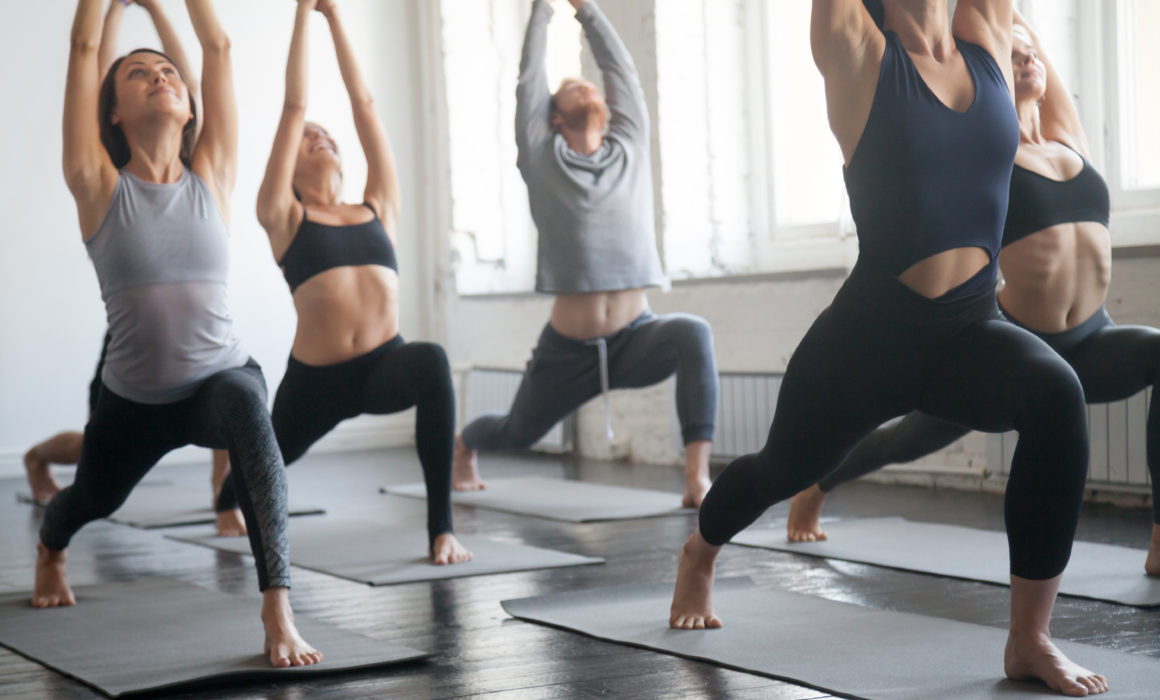
Yoga has been around for thousands of years and it’s not going anywhere.  Yoga is actually becoming more popular and here’s why you should be adding this workout into your routine.

No, you don’t need to do Yoga every day, but doing Yoga at least once a week will allow you to reap the benefits.

In todays world, mobility and stretching is something that often gets put on the back burner.  People are limited on time, especially when it comes to working out, so they want to make the most out of their workout time and unfortunately people don’t think stretching and mobility is valuable.  I could go on and on about why mobility and stretching are super important, but let’s keep it short: If you want to continue to do the things you love (working out, playing with your kids, walking around, etc.) we need to take care of our bodies in order to do that!

Let’s keep in mind that there are several different types of Yoga.  Some Yoga classes are more relaxing and holding stretches for a long amount of time.  Some classes are faster pace and more of a sweaty endeavor.  Some is active stretching.  So, when picking out a Yoga class to attend make sure to work with a Yoga instructor to see what style would best fit where you are currently at and what your goals are.

The Benefits

So, why Yoga then?  Yoga has both physical and mental benefits.  Let’s go over the physical benefits:

  • Increased flexibility
  • Increased muscle strength and overall tone
  • Improved respiration
  • Improved energy levels
  • Maintain a balanced metabolism
  • Weight reduction
  • Cardio and circulatory health
  • Improved athletic performance
  • Protection from injury

As you can see, there are several physical benefits to practicing Yoga and this is why Yoga is becoming bigger among athletes as well.

Let’s check out the mental benefits:

  • Helps manage stress
    • Stress can reveal itself in many ways: back and neck pain, sleeping problems, headaches, drug abuse (including caffeine), and an inability to concentrate.
  • More positive outlook on life
  • Create mental clarity and calmness
  • Increase body awareness
  • Relieve chronic stress patterns
  • Relax the mind
  • Center attention
  • Sharpen concentration

Are you stressed?  I can guess that the answer to that question is yes! Life is hectic, and it seems to continue to get even more busy.  Yoga can be a way to get to a healthy state of mind and allow you to enjoy life, even when it’s stressful.

Yoga is for every body!

Yoga is a very accessible workout for anyone and clearly there are several great benefits to this type of exercising.  Whether your just starting out or have been working out for several years, Yoga should be part of your routine.

Now, get out there and get your Namaste on!


Mobility vs. Flexibility: Which is Better?

Mobility vs. Flexibility: Which is Better?

Mobility is not synonymous with flexibility. People use the terms flexibility and mobility interchangeable, but recently fitness professionals have made a push to separate the two concepts.

Most people know that stretching is good for you for multiple reasons, this is usually based on how they feel after stretching. The reason why you may stretch is to relieve stiffness or tightness. What most people don’t understand is there are multiple factors that may contribute to tightness. There are also many ways to address tightness. Generally enhancing your mobility and or flexibility will help you move properly without restriction or pain. Your probably wondering, whats the difference between mobility and flexibility? These two terms seem to be used interchangeably, yet actually have different meanings. Let’s distinguish the difference between the two.

What is Mobility?

Mobility is our ability to take our body through a range of motion, before being restricted, with control. Mobility is having strength within your flexibility.

Mobility is needed to perform everyday activities and it’s especially important when working out or participating in sports. Our ability to move without restriction or pain means that we can comfortably perform daily activities and strength train. If your body isn’t moving through its natural movement patterns, you’re at risk of injury. If you think about your shoulder joint, which is shaped like a ball-and-socket, it’s designed to move in all directions. If your shoulder can move like it should, the joint is healthy and mobile. If you have restricted movement in one direction or another, like you can’t raise your arm next to your ear, then you a lack shoulder mobility. This increase your risk of pain and injury, especially when loaded.

What is Flexibility?

Flexibility refers to soft tissues (muscles and tendons) ability to temporality elongate. Our connective tissues are like finger traps; the amount of material doesn’t actually change, you can’t lengthen it, but you can contract it. Flexibility is passive. It’s your ability to move connective tissue with the help of a another person or tool, while their muscles passively allow the movement to happen. Flexibility means the soft tissues are stretchy and elastic.

Think of a rubber band. If you pull both ends, and it stretches like any good rubber band should, it’s flexible. If it doesn’t stretch, it’s inflexible. It’s the same thing with muscles, which actually have elastic components designed to help the muscle stretch.

Flexibility is important because when your body is restricted by inflexibility and you can’t move through your natural range of motion, pain can occur. Lack of flexibility can make all activities more difficult.

What’s the Difference?

The biggest difference between mobility and flexibility is that in order to move a joint through its range of motion with control (mobility), you need strength.Which is why mobility is a better indication of how well and efficiently we move. Flexibility is one part of mobility. But strength, coordination, and body awareness are also elements of mobility. Flexibility is a component of mobility, extreme flexibility usually isn’t necessary to perform most exercises or activities. That means that mobility can be limited by flexibility, but super-flexibility is not necessary for most people or strength athletes.

Someone with great mobility may be able to squat below parallel while maintaining joint integrity and posture with no restrictions of range of motion. A flexible person may be able to break parallel, but they lack the ability to maintain joint integrity and posture because they may not have the strength, core strength, balance, or coordination to perform the same motion.  Someone with poor mobility may be able to complete a partial rep with decent posture but does not have the range of motion necessary to break parallel. There are a number of possible muscle imbalances that can cause lack of mobility and flexibility,  but these problems can be fixed with a combination of soft-tissue work (foam rolling/massage), stretch, and strengthen.

Both mobility and flexibility are important. You need your muscles to have the strength to support your movements, and elasticity which allows you to move without restriction. Luckily, you can work on improving flexibility and mobility.

Here’s why you should be doing flexibility and mobility exercises.

  1. Eliminate joint pain or injury
  2. Perform movements with great range of motion
  3. Increase muscle recruitment
  4. Burn more calories
  5. Move with freedom
  6. Perform wider range of movements
  7. Prolong quality of life
  8. Increase strength
  9. Increase stability
  10. Increase speed/power
  11. Enhanced joint health

How to Increase Your Mobility and Flexibility?

To enhance your flexibility and mobility, start with areas that you are really tight or areas affected by bad posture. This may include the neck, mid/low back, hip flexors, glutes, hamstrings, and calf muscles.

3 methods to increase mobility: 

  1. Foam Rolling: foam rolling is essentially a self-massage technique to help you release trigger points or “knots” in your muscles.
  2. Mobility Drills: These are exercises that are specifically geared towards training your range of motion around joints.
  3. Stretch: This isn’t always necessary, especially if you’re a naturally bendy person stretching can make your joints more vulnerable to injury than if you just left it out. But if you’ve always been fairly stiff, and it’s stopping you from performing exercises correctly, you may benefit from a few short stretches as part of your warm up, and longer stretches for after your workout.

Now that you know everything you need to know about mobility vs flexibility, here is a short routine that you can do daily to enhance your flexibility and mobility for better workouts, enhanced performance, and overall health/quality of life.


Optimize Your Time at the Gym with These 4 Training Methods

Optimize Your Time at the Gym with These 4 Training Methods

Michol Dalcourt developed the 4Q Model after years of research.  Who’s Michol Dalcourt?  He is the founder of the Institute of Motion, inventor of a piece of equipment called the ViPR (see picture below), and co-founder of PTA (Personal Training Academy) Global.

Now that you know Dalcourt’s credentials, let’s take a look at the 4Q Model:

As you can see in the graph, there are 4 quadrants of training:

  1. Loaded Linear Training
  2. Unloaded Linear Training
  3. Loaded Movement Training
  4. Unloaded Movement Training

There are also X and Y axis.  The X axis is linear movement and transitional movement.  Linear movement is one-dimensional movement along a straight line.  Transitional movement is moving from one position to another.  Think about babies for this one – yes, babies.  For instant, a baby rolling, getting up to standing and getting back to the floor from standing, etc.  The Y axis is Loaded and Unloaded – meaning weighted or non-weighted.

So, now that we have clear understanding of what the 4Q Model is, let’s dive in deeper to each quadrant:

  1. Loaded Linear Training: This is probably the most common training you would see in a gym, more specifically in the weights area.  This type of training is linear, movement from front to back and side to side (Frontal and Sagittal Planes of Motion).  It is loaded, meaning that you have some type of weight during this type of training methodology.  As you can see in the model this includes exercises such as Bench Press, Deadlift, Hang Clean and Bicep Curl.
    • Benefits of this method:
      • Greater muscle Hypertrophy
      • Time under tension
      • Increase hormonal release
      • Improvement in Stability / Strength / Power
      • Improved intra-muscular coordination
  2. Unloaded Linear Training: Very similar to Loaded Linear Training, but unloaded (so no weight).  Some examples, as see in the model, are running, cycling and swimming.
    • Benefits of this method:
      • Re-education of neuro-muscular system
      • Stability / Mobility training
      • Weak Link Activation
      • Targeted tissue improvement (i.e. muscle)
      • Improved intra-muscular coordination
      • – Cardio and motor efficiency
  3. Unloaded Movement Training: This is multi-plane, unloaded training.  Think about the baby – crawling, rolling, standing from a seated position and getting back to seated from standing.  Some examples, aside from the ones in the model, includes yoga.
    • Benefits of this method:
      • Rapid NS activation
      • Mostability training
      • Improved Motor learning
      • Speed, agility, quickness improvements
      • Increase functional reaction capabilities
  4. Loaded Movement Training: This is multi-plane and loaded.  Examples of this method include warding patterns and ViPR training (tool pictured above).
    • Benefits of this Method:
      • Greater adaptations in muscle, nerve, skin, fascia
      • Less compressive forces
      • Increase hormonal release
      • Improvement in multi-directional Stability / Strength / Power
      • Improved inter-muscular coordination
      • Whole body integration

So, what method is the best?  There’s not one training method that is better than the other and creating a program that’s comprehensive with all of these methods is ideal.  There are several benefits to each method and if you want results, having a combination of all of these will get you there.  With that said, you can see how Loaded Linear, Unloaded Linear and Unloaded Movement Training are all rather popular.  Loaded Movement Training, although it’s becoming more popular, it’s still a method that is challenging to ensure you train.  The reason why you want to train using this method is because it will create a more resilient human body.  If you think about it, we do things such as carrying groceries from the car to the house.  We carry toddlers on our hips.  We reach down on the ground to pick something up or reach up to get something out of the cabinet.  We are constantly in  multi-planes with load throughout our lives.  So, if we also train in this way, we create a more resilient human body!  Try adding this to your next workout routine.  If you can’t get your hands on a ViPR for training, try adding some of these movements to your workouts:

Weighted T-Plane Squat

Weighted Halo Chop

Wood Chopper

Squat with Figure-8

Those are just a few to get your head in the right mind space.  Get creative!  If your wanting help creating a comprehensive program that includes all 4 methodologies of the 4Q Method, let us know!  We’d be happy to help.

*Reference: Michol Dalcourt, Institute of Motion: Loaded Movement Training

Why High Intensity Interval Training is a Big HIIT.

Why High Intensity Interval Training is a Big HIIT!

High Intensity Interval Training (HIIT) is some version of a brief period of all-out effort followed by a rest period.  Here’s everything you need to know about HIIT Training and how you can reap the benefits from this sufficient workout method.

Why is Hight Intensity Interval Training a big HIIT?

  1. Efficient: HIIT Sessions are short, but definetly not sweet.
  2. Effective: Studies have proven this method as extremely effective.
  3. Multi-Purpose: No matter what your goals are, this training methodology is for you.

Efficient: Why is HIIT such an efficient method of training?

To answer this question, first we must look at what types of work-to-rest ratios we should be using:

1:1 – example: 30 seconds on, 30 seconds off

2:1 – example: 40 seconds on, 20 seconds rest

3:1 – example: 45 seconds on, 15 seconds rest

For beginner HIIT athletes, start off with a 1:1 work-t0-rest ratio and incrementally increase as you become more conditioned.

The key is to ensure that your all-out effort is truly all-out.  So, the length of your training can vary as well. Length of time should be determined by your all-out effort.  So how long should your HIIT sessions last?  It’s time to quit when you can no longer maintain an all-out effort for the designated work time frame.  Typically, this time frame is no longer than 45 minutes.  This is why this method has gained its popularity.  If you are short on time, it’s a great way to be efficient with your time.

Effective: 

Studies have proven that HIIT training helps you burn more fat for up to 24 hours after your session.  This method puts your body into overdrive with repair processes, therefore, your body burns more fat while in repair mode.  Studies have proven HIIT to be an effective way to lose weight, while also not sacrificing muscle.  More muscle on the body means that you burn more fat at rest as well.  Not only that, but HIIT increases the production of your Human Growth Hormone (HGH).  This increases caloric burn and also reduces the aging process.  These are just a few benefits of HIIT training, which only proves this method even further.

Multi-Purpose: 

Whether your have goals of fat loss, increasing muscle while maintaining a lean physique, or athletic performance, this method may be used to help you reach your goals!  This is a big reason why this method has gained such popularity.

Some things to mention about HIIT:

Adding 2 sessions a week is an ideal amount to reap the benefits from HIIT training.  Why should I do it only 2x a week if it’s so effective and efficient?  The whole idea of HIIT training is to shock your central nervous system and constantly challenge your body to adapt in new ways, meaning you will get results.  If you were to do HIIT training every day, the body would adapt and it would become less effective, so keep this in mind while developing your workout routine.

As you can see, HIIT is a great tool to add to your regimen!  Find a beginners HIIT workout below.  Go get ’em!

Beginners HIIT

Exercise 1: 30 seconds work, 30 seconds rest + Exercise 2: 30 seconds work, 30 seconds rest; each round 3x

Round 1: Push-Ups + Burpees

Round 2: Squats + Side to Side Squat Jumps

Round 3: Plank Shoulder Taps + 4 Cross-body Mountain Climbers and 4 Jumping Jacks

Round 4: Reverse Lunges + Split Squat Jumps

Round 5: Bicycle Crunches + Shuffle side to side


Privacy Settings
We use cookies to enhance your experience while using our website. If you are using our Services via a browser you can restrict, block or remove cookies through your web browser settings. We also use content and scripts from third parties that may use tracking technologies. You can selectively provide your consent below to allow such third party embeds. For complete information about the cookies we use, data we collect and how we process them, please check our Privacy Policy
Youtube
Consent to display content from - Youtube
Vimeo
Consent to display content from - Vimeo
Google Maps
Consent to display content from - Google